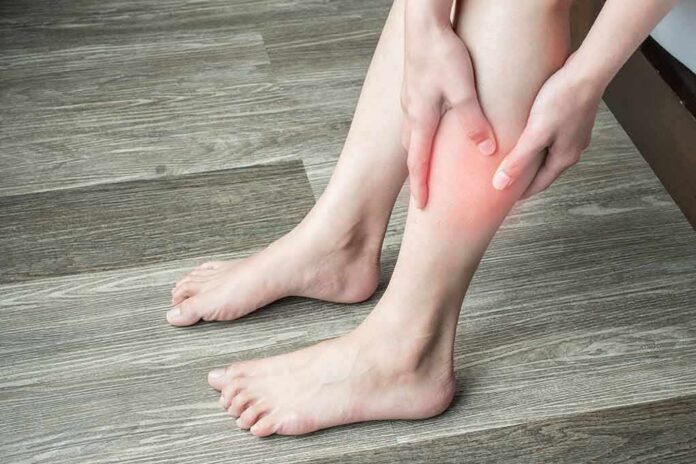
Your leg screams, but the troublemaker sits higher—pinching nerves in your lower back.
Story Snapshot
- Sciatica pain often comes from compressed nerve roots in the low back, not the leg.
- Herniated discs and bone overgrowth are the top culprits “upstream” of the sciatic nerve.
- The pain map down your leg depends on which spinal nerve gets squeezed.
- A small share of cases start outside the spine, so red flags and smart exams matter.
Why your leg burns when your back is the problem
Doctors use the word sciatica for pain that travels from the low back into the buttock and down the leg. Most people feel it in the calf or foot and assume the sciatic nerve in the leg is damaged. The common source sits higher. Pressure on the spinal nerve roots that form the sciatic nerve, most often L5 or S1, drives the pain signal along that long pathway. The leg yells, but the pinch point is near the spine. That is why treating only the leg often fails.
The most frequent trigger is a herniated disc. A disc can bulge or leak material into the canal and press on a nerve root. Bone spurs and thickened ligaments can also narrow space and squeeze nerves. These changes inflame the nerve root. Inflammation adds chemical pain on top of mechanical pressure. Mayo Clinic calls this an upstream problem that sends symptoms downstream along the nerve. This explains why coughs, sneezes, or sitting can spike symptoms when pressure rises around the root.
How to decode which nerve is crying for help
The exact path of pain offers clues to the level. L5 root irritation often shoots pain down the outer leg into the top of the foot. S1 root trouble tends to hit the back of the leg into the sole and little toes. Weakness patterns match too, like trouble standing on heels (L5) or toes (S1). A careful exam checks strength, reflexes, and straight leg raise to stress the nerve root. Reviews describe this focused workup as the backbone of early diagnosis. Imaging can wait unless red flags appear.
Red flags demand fast action. Sudden loss of bowel or bladder control, saddle numbness, cancer history, fever, major trauma, or fast-worsening weakness need urgent care. Research summaries note that while most cases trace to a herniated disc, a small but serious group stems from other causes, including spinal stenosis and, rarely, tumors or infection. Good care starts with sorting routine radiculopathy from the rare, dangerous lookalikes. That is conservative, common-sense triage.
Why the “it’s not your leg” message lands—and where it can mislead
The Institute of Human Anatomy popularized a blunt claim: you feel it in the leg, but the cause lives in the back. Major centers echo that core point. Hospital for Special Surgery explains that pain feels like it is from the buttock sciatic nerve, yet most cases start from an irritated lower-spine nerve. That matches the mainstream view and helps people stop chasing only hamstring or calf fixes. The line is sharp, simple, and, for most cases, right where it counts.
But sciatica is a syndrome, not a single disease. A small share begins outside the spine. Deep gluteal entrapment, pelvic masses, cysts, or even an injection injury can mimic or cause sciatic pain. Reviews catalog these extraspinal causes and urge doctors to think wider when the story does not fit, or when treatment fails. The lesson is balance. Start with the likely back source. Stay alert for exceptions. That is the prudent path that respects both data and patient time.
What actually helps most people feel better
Most sciatica improves without surgery. Short rest, then steady movement, often beats bed rest. Anti-inflammatory medicine can ease the flare. Guided physical therapy builds core strength, hip mobility, and nerve glide. If pain stays severe, an epidural steroid injection may calm the inflamed root enough to unlock progress. Surgery becomes an option when there is major weakness, red flags, or pain that will not yield after a fair trial. StatPearls highlights disc herniation as the leading target when surgery is needed.
Bottom line for your next flare
Check your map. If pain runs below the knee, think nerve root, not just muscle strain. Note what worsens it: long sitting, bending, or coughing point to the spine. Track any numbness or weakness. Seek help fast for red flags. Ask your clinician which root fits your symptoms and what the plan is to calm it. The fastest wins come from treating the true source. The pain might shout from your leg, but the fix often starts in your back.
Sources:
mayoclinichealthsystem.org, pmc.ncbi.nlm.nih.gov, newsnetwork.mayoclinic.org