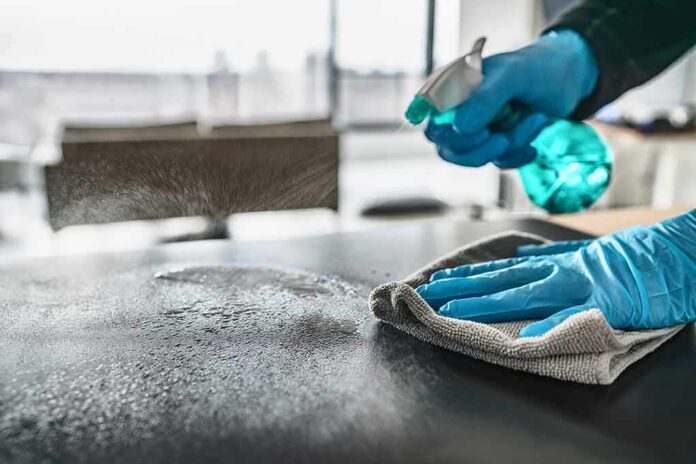
The lemon-fresh smell drifting through your kitchen after a good scrub down might carry more than a pleasant scent. Purdue University researchers say scented cleaning products react with ordinary indoor ozone to create massive numbers of invisible nanoparticles, some fine enough to travel deep into human lungs.
Quick Take
- Purdue researchers led by Brandon Boor found scented cleaners react with indoor ozone to form nanoparticles within minutes of use.
- Both conventional cleaners and “natural” botanical or essential oil-based products triggered the same chemical reaction.
- The particle dose from mopping and wiping surfaces reportedly rivaled levels found near busy city traffic.
- Terpenes, the compounds behind citrus and pine scents, are the main chemical driver of the reaction.
How A Simple Chore Turns Into A Chemistry Experiment
Every home carries a small amount of ozone, drifting in from outside air or generated by devices like printers and air purifiers. Cleaning product researchers found that when scented products meet that ozone, a fast chemical reaction begins almost immediately. Terpenes, the natural oily compounds that give cleaners their lemon or pine smell, are highly reactive and break down quickly once exposed to ozone indoors.
That breakdown does not just make the smell fade. It kicks off a chain reaction that builds brand-new particles out of thin air. Researchers describe billions to trillions of these ultrafine particles forming during normal cleaning tasks like mopping floors, spraying counters and wiping surfaces with scented products. Because the particles are so small, standard air filters and even the human eye cannot detect them.
Why Size Matters More Than You Think
Some of these particles measure smaller than three nanometers across, a category scientists call nanocluster aerosol. Purdue’s team found scented chemical products can match or even beat gas stoves and car engines in producing this ultra-tiny pollution class indoors. That comparison matters because gas stoves and engine exhaust are already recognized as legitimate air quality concerns worth managing in homes and cities alike.
Lead researcher Brandon Boor put the health stakes plainly, noting the indoor ozone reactions with cleaning fragrances can produce an inhaled particle dose comparable to standing near heavy traffic. That is a striking claim for something happening inside a closed kitchen or bathroom rather than alongside a highway. The smaller a particle gets, the deeper it can travel into the respiratory system, reaching areas larger dust particles never reach.
Natural Labels Do Not Change The Chemistry
Consumers reaching for “green” or essential oil-based cleaners hoping to dodge this problem may be disappointed. Boor’s team found botanical and essential oil-based products triggered the same rapid reaction with indoor ozone as conventional scented cleaners. The terpenes responsible for pine, citrus and floral scents behave the same way in the air whether they come from a lab or a plant.
This tracks with broader indoor air research going back two decades, which has long shown fragranced products emit volatile organic compounds capable of reacting with ozone to form secondary pollutants including formaldehyde and ultrafine particles. Separate reviews examining “green” cleaning claims found no strong evidence that naturally scented products produce cleaner indoor air than standard alternatives. The marketing language on a bottle, in other words, tells you little about what happens once that scent hits your living room air.
What Homeowners Can Actually Do About It
Researchers point to practical fixes rather than telling families to abandon cleaning altogether. The suggested approach centers on ventilation, meaning opening windows or running exhaust fans while cleaning to push both the scent and the resulting particles outside before they build up indoors. Reducing the concentration of scented product used per cleaning session also lowers the raw material available for the ozone reaction to consume.
None of this means Americans need to panic about their cleaning supplies or toss every scented product under the sink. It does mean paying closer attention to airflow during and after cleaning, especially in smaller rooms with less natural ventilation. Common sense home habits, cracking a window, running a fan, giving a room time to clear, cost nothing and address a real chemical process happening in millions of households every single day.
🚨🫧 Scented cleaners and indoor ozone can generate ultrafine nanoparticles
Pollution can form within minutes of cleaning.
Particles may number billions to trillions and penetrate deep into the lungs.
(American Chemical Society) pic.twitter.com/O4QTpq3JBi
— Insights | Integration🖊️ (@conect_insights) September 27, 2026
The science here sits on solid ground, built from years of prior research into terpene oxidation chemistry combined with new measurements from Purdue’s model home testing. Families do not need to fear their mop bucket, but they should treat fresh scent as a signal worth a little extra airflow rather than pure reassurance that a space is truly clean.
Sources:
acs.org, engineering.purdue.edu, purdue.edu, techexplorist.com, scitechdaily.com, pmc.ncbi.nlm.nih.gov, pubs.rsc.org