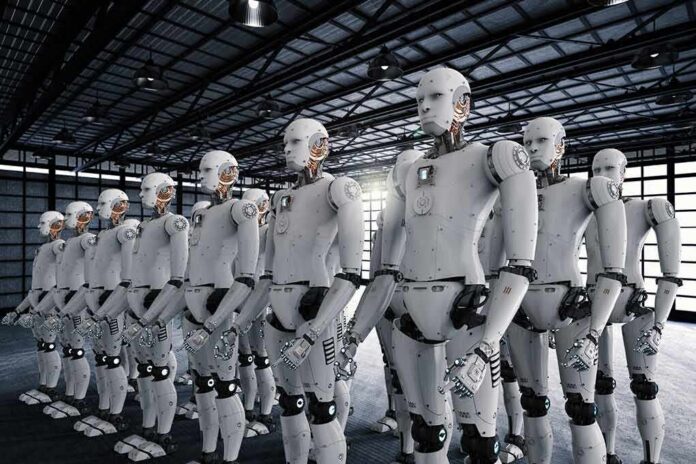
Robots played ping-pong and folded laundry on stage this year, yet the same technology still trips over tasks a toddler could handle.
Story Snapshot
- Robotics companies showed off live demos in 2026 featuring humanoid robots with dexterity, speech, and fleet coordination.
- A major international safety report calls today’s AI “jagged,” meaning it can do hard things but fail at easy ones.
- Independent economic studies find real productivity gains in controlled tests, but much smaller effects once companies try to use AI at scale.
- The honest picture sits between hype and dismissal: fast progress in narrow tasks, slow and uneven progress everywhere else.
The Demos Look Like Science Fiction
At trade shows this year, companies rolled out robots that seemed pulled from a movie set. AGIBOT showed a “comprehensive robotic ecosystem” with hundreds of units already working in real projects, combining walking, grabbing, and talking in one machine. Sharpa’s robot North played ping-pong with a 0.02-second reaction time during a live demo at CES 2026. These are not concept sketches. They are machines moving in front of real crowds.
Hyundai’s Atlas prototype and Boston Dynamics’ Spot performed industrial inspection tasks on stage, powered by orchestration software meant to manage entire robot fleets. For anyone watching, the message is clear: AI has left the lab and entered the warehouse floor. That part of the story is not in dispute. The question is what these demos actually prove about the technology’s readiness for everyday, unscripted work.
The Safety Report Tells A Different Story
The International AI Safety Report 2026, backed by researchers from multiple countries, describes today’s systems as “jagged.” They can ace a hard coding problem, then fail at something a simple, but they still fail at tasks that require many steps in a row. The report says AI still cannot reliably reason about the physical world, and it cannot yet plug into robotic hardware to do basic housework. That is a sharp contrast to the polished demos audiences see on stage.
The same report notes something conservatives should take seriously: general-purpose AI systems remain “prone to basic errors of fact and logic,” even after years of investment. Performance also drops in languages and cultures outside the main training data, meaning the technology’s reach is narrower than marketing suggests. None of this denies real progress. It means the gap between a trade-show demo and a dependable worker is still wide.
What The Economic Data Actually Shows
Away from the stage lights, economists have been quietly measuring what AI does for real businesses. Controlled experiments find individual workers get 14 to 40 percent more done with AI help, especially newer employees. That is a genuine gain, and it matters for anyone running a small business or managing a team. But once you zoom out to the whole economy, the numbers shrink fast, echoing a pattern economists have seen before with past technology booms.
A Goldman Sachs analysis found fewer than 19 percent of U.S. businesses have actually adopted AI, despite years of headlines proclaiming a revolution. Nearly 90 percent of surveyed executives report no measurable effect on productivity from AI so far. Carnegie Endowment researchers point to a “reliability gap,” arguing AI systems fail at complex, multi-step work often enough that they cannot yet be trusted to run unsupervised. That is not anti-technology pessimism. It is a sober accounting of what businesses are actually experiencing.
What This Means For Working Americans
The honest answer to “what is actually new” is this: task-level speed is real, but full replacement of human judgment is not close. A Substack analysis of current capabilities bluntly states that AI “still fails at cross-domain generalization, causal reasoning, long-horizon planning, and anything requiring embodied or real-world understanding”. That should reassure workers worried about being replaced overnight, while still respecting the fact that specific tasks are genuinely getting automated faster than expected.
AI is a powerful tool for narrow jobs, spreadsheets, drafts, inspections, but it is not the all-knowing replacement for human workers that Silicon Valley marketing implies. Policymakers should resist regulating based on hype reels and instead look at what the data shows: uneven adoption, persistent errors, and a technology still finding its footing outside the demo stage.
Sources:
time.com, sciencedaily.com, inorbit.ai, indiatodayne.in, markets.businessinsider.com, internationalaisafetyreport.org, nasdaq.com, businesswire.com, engineering.ucdavis.edu