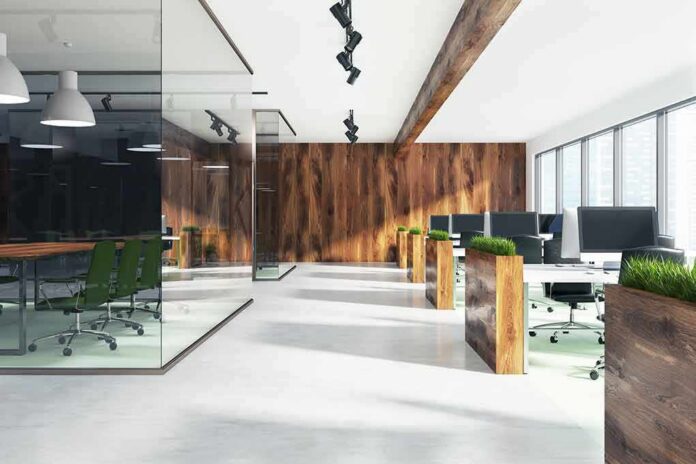
The desk you sit at, the noise you tune out, the thermostat you can’t touch — none of it is neutral. Decades of workplace research now converge on a finding that should unsettle anyone who thinks behavior at work is purely a matter of willpower, culture, or management style: the physical environment itself is quietly steering how people feel, focus, move, and treat each other, often without their awareness.
Key Points
- Peer-reviewed research treats the physical office as a source of “affective events” that shape emotion and behavior, not just a passive backdrop.
- Specific, measurable factors — temperature range, spatial density, noise, privacy, and control over one’s environment — are linked to satisfaction, sickness absence, and performance.
- Open-plan layouts consistently show worse outcomes on privacy and noise; private offices and environmental control show better ones, though effects vary by task and person.
- Office design measurably increases or decreases physical activity during the workday, independent of individual motivation.
- The evidence is strongest for offices specifically; extending these findings to factories, retail floors, hospitals, or home offices requires caution.
The Environment as an Active Participant, Not a Backdrop
For most of the twentieth century, organizational psychology treated the office as scenery — the stage on which the real drama of management, incentives, and personality played out. That assumption has not aged well. A widely cited essay in the Journal of Organizational Behavior reframes the physical workplace through an “affective events” lens, arguing that features like personal space, spatial density, territoriality, and personalization actively generate emotional reactions that ripple into behavior. Under this model, an open-plan floor isn’t just a layout choice; it’s a continuous generator of small emotional triggers — an overheard call, a claimed desk, a sightline you can’t escape — that accumulate into mood, then into conduct.
A 2025 integrative review in an academic management journal pushes this further, synthesizing decades of scattered findings into a coherent picture: ambience, spatial configuration, and aesthetics measurably influence physical and mental health, motivation and attitudes, and the actual processes by which work gets done. This is not a fringe claim confined to design journals. It has migrated into government policy guidance, where UK reports on employee wellbeing catalog office layout, furniture, lighting, temperature, and — critically — the degree of control employees have over their surroundings as established determinants of how people feel and perform at work.
The Mechanics: Temperature, Density, and the Cost of Cramped Space
Some of this evidence is granular enough to be actionable. A UK government report states plainly that the physical environment “has been shown to have a powerful role in shaping a range of psychological and behavioural outcomes for employees”. It gets specific: spaces perceived as cramped correlate with lower job satisfaction, reduced efficiency, and a measurably higher risk of long-term sickness absence. Temperature follows a similarly precise pattern — the same report identifies 22 to 26 degrees Celsius as the performance-optimal band, with conditions outside that range associated with declines in both work performance and motivation. These aren’t soft impressions; they are the kind of finding a facilities manager could act on tomorrow, and many corporate real estate teams already do.
Density and privacy tell a related story. A doctoral synthesis out of Cardiff found that open-plan offices, unsatisfactory ambient conditions, lack of privacy, noise dissatisfaction, and increased spatial density are repeatedly linked to poorer wellbeing, while private offices, environmental control, exposure to daylight, and biophilic elements — plants, natural materials, views of greenery — track with better outcomes. A 2024 study adds texture: psychosocial strain and emotional exhaustion differ measurably across cell offices, shared-room offices, combi-offices, and hot-desking arrangements, with cell offices generally outperforming on several dimensions except psychological demands, where shared rooms fared better. The pattern that emerges is not “open-plan bad, private office good” — it’s that different configurations trade one kind of wellbeing for another, and no single layout wins across the board.
Movement, Design, and the Body’s Response to Layout
The physical environment doesn’t just shape mood — it shapes what the body does over an eight-hour shift. A systematic review found that offices built around active design principles, incorporating visible stairs and flexible workspaces that encourage people to get up and move, produced measurable increases in physical activity across nine separate studies, making layout-driven design the most effective lever for boosting movement at work, more so than sit-stand desks alone, which reduced sitting time but had only a minimal effect on overall activity. This matters because sedentary behavior carries its own well-documented health costs, and it illustrates a broader point: employees rarely choose sedentary patterns purely out of preference. The building nudges them into it, or out of it, often before conscious decision-making enters the picture.
Where the Real Disagreement Lies
The honest caveat here is not whether the physical environment matters — that point is well established — but how uniformly it matters. One review explicitly notes that workplace features function as both resources and demands simultaneously, meaning the same open floor plan that boosts spontaneous collaboration for one team can suppress deep focus for another. That dual nature is the reason design debates never fully resolve: critics can always point to a study where open-plan hurt outcomes and a different one where it helped, and conclude the research is contradictory, when what it actually reflects is context sensitivity — task type, personality, team culture, and the degree of control an employee has over their immediate surroundings all modulate the effect.
A second, more structural caveat: most of the strongest evidence here concerns office work specifically. Extending these conclusions wholesale to factory floors, hospital wards, retail environments, or home-based remote work outstrips what the current literature actually demonstrates. The mechanisms — density, control, noise, sightlines — plausibly generalize, but the studies proving it for non-office settings are thinner. Readers should treat the office-specific findings as well-supported and the broader extrapolation as a reasonable hypothesis rather than a settled fact.
What This Means for How Workplaces Get Built and Managed
The practical upshot is that employee control over the immediate environment — the ability to adjust lighting, choose seating, manage noise exposure, or step into a quiet space — repeatedly surfaces as a high-leverage factor across multiple independent bodies of evidence. That has quiet implications for how organizations think about cost-cutting through dense, uniform, open-plan real estate: the square-footage savings are real and immediate, but the wellbeing, absenteeism, and performance costs documented in this literature are also real, just slower to show up on a balance sheet. Employers and designers who treat layout as purely an aesthetic or cost decision are, in effect, making a behavioral intervention without acknowledging it as one — and the research increasingly makes that ignorance a choice rather than an excuse.
Sources:
mindbodygreen.com, pmc.ncbi.nlm.nih.gov, providencehealthplan.com, gov.uk, assets.publishing.service.gov.uk, onlinelibrary.wiley.com, medium.com