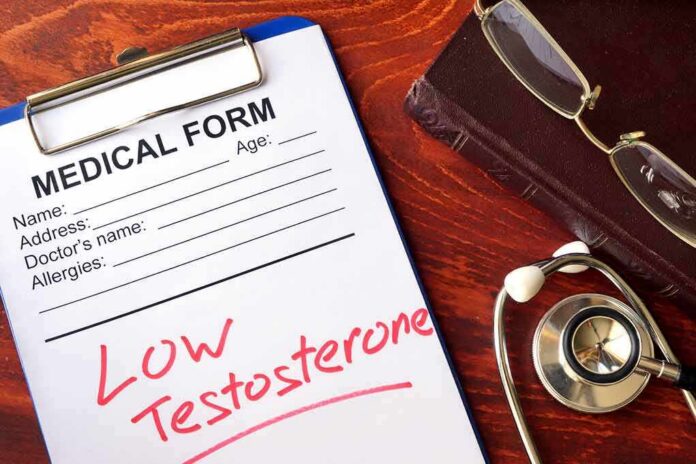
Men with the lowest testosterone levels face an 18% higher risk of dying from cancer than men with the highest levels, according to a major new international study.
Story Snapshot
- Researchers tracked more than 26,000 men and found low total testosterone linked to higher cancer death risk
- The lowest testosterone group showed a hazard ratio of 1.18 compared to the highest group
- Low dihydrotestosterone, a related hormone, also tracked with higher cancer death risk
- Scientists stress this is a link, not proof that low testosterone causes cancer
What The New Research Actually Found
The study pooled individual data from men around the world, making it one of the largest looks ever taken at testosterone and cancer outcomes. Men sorted into the lowest fifth of testosterone levels had a hazard ratio of 1.18 for cancer death compared to men in the highest fifth, with a confidence range of 1.04 to 1.34, according to the published findings in Lancet Healthy Longevity.
Low levels of dihydrotestosterone, a hormone the body makes from testosterone, showed the same troubling pattern. Men with the least of it also faced higher odds of dying from cancer. Researchers say this points to a broader hormone signal worth watching, not a single rogue number on a lab report.
Why This Looks Like A Warning Sign, Not A Cause
The scientists behind the work are careful on one key point. Low testosterone tracking with cancer death does not mean low testosterone causes cancer. It may instead work as an early warning sign, flagging men whose bodies are already under broader health strain from aging, illness, or disease before diagnosis ever happens.
That distinction matters for how doctors and patients should react. A blood test showing low testosterone is not a cancer diagnosis. It is a data point that may deserve closer attention, especially paired with other symptoms, rather than a reason to panic or rush into hormone treatment on its own.
The Treatment Question Doctors Still Can’t Fully Answer
Here is where the story gets tricky for men looking for a fix. Showing that low testosterone predicts poor outcomes is a different question from showing that raising testosterone through therapy improves those outcomes. Medical guidance has long treated known or suspected prostate cancer as a reason to avoid starting testosterone therapy altogether.
The Endocrine Society recommends assessing prostate cancer risk before starting treatment and monitoring patients for months afterward. A large 2026 review of 41 randomized trials found no significant jump in major cardiac events or clinically significant prostate cancer among men on testosterone therapy, offering some reassurance for carefully screened patients.
Large int'l study (26k+ men) found very low testosterone associated with 18% higher later cancer mortality. https://t.co/WHdFmoj1cD
That's on top of the fact that testosterone levels have dropped 50% in men of equal age over the last 50 years.
— Dr. Greg Nigh (@gnigh) November 8, 2026
Earlier thinking in medicine worried that more testosterone might feed prostate tumors, a concept rooted in old androgen-deprivation research. Newer observational and trial data have not shown a clear short-term rise in prostate cancer events among men on therapy, which has shifted the conversation toward monitoring rather than outright avoidance for most men.
What This Means For Men Reading Their Lab Results
Men over 40 are exactly the audience most likely to get a testosterone test ordered, whether for fatigue, low drive, or routine checkups. This research gives that number new weight. A low reading is not just about energy or muscle. It may reflect something happening deeper in the body that doctors should take seriously.
The sensible response is not fear, and it is not self-prescribing hormone boosters bought online. It is a conversation with a doctor about full bloodwork, prostate screening, and overall health history. Current guidance still calls known or suspected prostate cancer a reason to hold off on starting testosterone therapy entirely.
Long-term safety questions, including cancer risk tied to therapy itself, remain unsettled enough that the Endocrine Society continues to call for careful screening and monitoring before and during treatment. That is not contradiction. That is medicine moving carefully on a hormone tied to basic male biology, instead of rushing a verdict either direction.
Sources:
sciencedaily.com, researchnow.flinders.edu.au