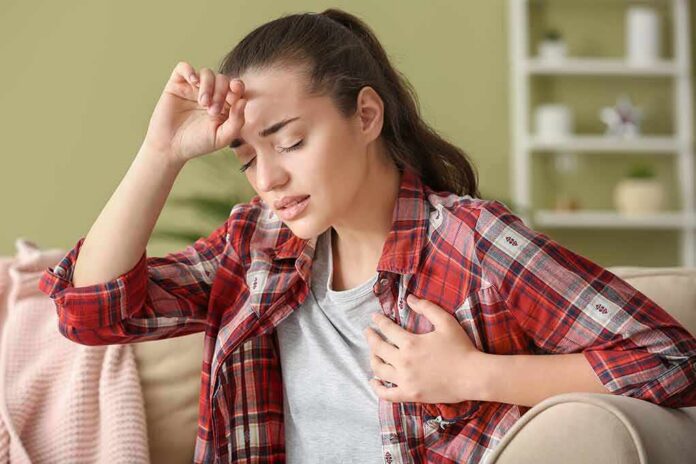
A pounding, irregular heartbeat after a night of holiday drinks has a real medical name, and doctors have tracked it for nearly 50 years.
Quick Take
- Doctors call it Holiday Heart Syndrome: an irregular heartbeat, usually atrial fibrillation, that shows up after binge drinking.
- A New Jersey doctor named Ettinger first described it in 1978 after seeing 24 hospital patients with the same pattern.
- A 2020 clinical trial found cutting back on alcohol lowered the chance of atrial fibrillation coming back.
- The nation’s top heart guideline now tells patients trying to control their heart rhythm to cut alcohol way down or quit.
A Decades-Old Pattern With A Catchy Name
Doctor Philip Ettinger gave the condition its name in 1978. He studied 24 patients who ended up in the hospital with atrial fibrillation after weekend binge drinking. Atrial fibrillation is a fast, chaotic heartbeat that starts in the heart’s upper chambers. Ettinger’s patients had no known heart disease. Their hearts simply misfired after too much alcohol, often on a weekend or around a holiday.
Modern research confirms the same pattern keeps happening. A 2024 literature review found a strong link between binge drinking and new atrial fibrillation cases, including in people with no structural heart problems. The condition shows up most during times of heavy social drinking: New Year’s Eve, the Fourth of July, Super Bowl weekend, and the stretch between Thanksgiving and New Year’s. Emergency rooms see a predictable spike during these windows.
What The Strongest Study Actually Found
The best evidence on alcohol and atrial fibrillation comes from a 2020 trial published in the New England Journal of Medicine. Researchers in Australia studied 140 regular drinkers who already had atrial fibrillation. Half cut out alcohol. Half kept drinking as usual. The results were clear. Only 53 percent of the abstinence group had their atrial fibrillation come back, compared to 73 percent of the group that kept drinking.
The abstinence group also had much less total time in an abnormal rhythm, a measurement doctors call “burden.” Their median burden was 0.5 percent, versus 1.2 percent for those who kept drinking. Those numbers gave doctors hard proof that cutting alcohol does more than just feel healthy. It measurably protects the heart’s rhythm in people already fighting atrial fibrillation.
Why The Nation’s Top Heart Doctors Changed Their Advice
The 2023 guideline from the American College of Cardiology, the American Heart Association, and two other major medical groups now lists alcohol as a risk factor doctors should actively manage. It tells patients trying to control their heart rhythm to minimize or eliminate alcohol entirely to cut down on repeat episodes. That is a direct, specific instruction, not a vague suggestion to “drink responsibly.”
The guideline also points to research showing alcohol can trigger an episode fast. One case-crossover study found the odds of an atrial fibrillation episode roughly doubled within four hours of a single drink. That is a short window. It tells doctors the heart can react almost immediately to alcohol, not just after years of heavy use.
What The Evidence Does Not Yet Settle
The big trial studied people who already had atrial fibrillation and drank regularly and heavily, at least 10 drinks a week. It does not prove exactly what happens to a healthy person who binge drinks once at a holiday party and has never had a heart problem before. Doctors also cannot yet point to one exact drink count that triggers an episode in every person, since bodies react differently.
Sorting Out Alcohol From Everything Else That Happens At Holiday Parties
Holidays bring more than alcohol. Late nights, skipped sleep, salty food, stress, and dehydration all hit at once. The research does not fully separate how much of a holiday heart episode comes from alcohol alone versus these other factors piling up together. That does not erase the alcohol link. It just means the full picture at a holiday party is more crowded than a single culprit.
The bigger lesson for readers over 40 is straightforward. An irregular heartbeat after a big night out is not a quirky holiday myth. It is a documented medical pattern with a name, a mechanism, and now a guideline-backed response: cut the alcohol, especially if your heart has already acted up once before.
Anyone who feels a racing or fluttering heartbeat after drinking, especially if it lasts more than a few minutes, should get it checked rather than wait it out. A single episode does not always mean lasting heart disease, but doctors agree it is worth an electrocardiogram and an honest conversation about drinking habits.
Sources:
youtube.com, nejm.org, pubmed.ncbi.nlm.nih.gov