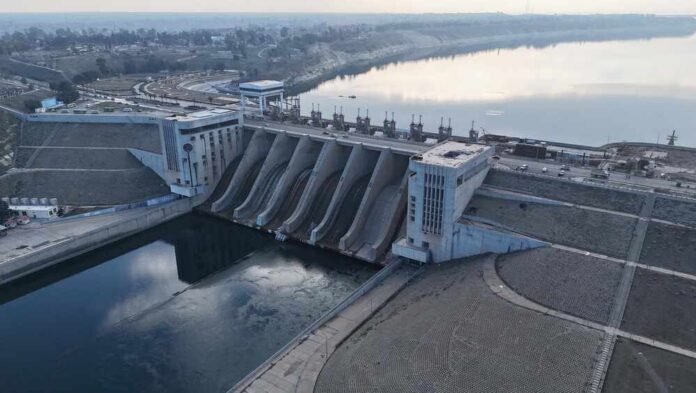
Lake Powell is now just 27 feet above the elevation where Glen Canyon Dam goes completely dark — and the water is still falling.
Story Snapshot
- Lake Powell sits at roughly 3,524 feet, only 24 feet above the level where the dam stops making electricity.
- The lake dropped 36 feet in a single year and now holds just 23-24% of its total capacity.
- Federal officials cut water releases from 7.48 million to 6 million acre-feet through September 2026 to slow the decline.
- Forecasters predict the lake could hit a record low in August 2026 — the worst level since it first filled in the 1960s.
The Number That Should Alarm You
Glen Canyon Dam has one hard floor: 3,500 feet above sea level. Drop below that, and the turbines stop. No electricity for the millions of homes and businesses that depend on them. Lake Powell is currently sitting at 3,524 feet. That gap — 24 feet — sounds like a lot until you realize the lake fell 36 feet in just the past year.
The Bureau of Reclamation’s own forecast, issued May 5, 2026, projects unregulated inflow into Lake Powell at just 3.27 million acre-feet for the water year — roughly 34% of the historical average. That is not a rounding error. That is the river delivering barely one-third of what the system was built to handle.
What “Dead Power Pool” Actually Means
Some reporting has blurred two different thresholds, so let’s be clear. The “minimum power pool” sits at 3,500 feet. That is where the dam can no longer spin its turbines to generate power. The true “dead pool” — the level where no water can flow out of the dam at all — sits much lower at 3,370 feet. The current crisis is about the power threshold, not the absolute bottom. That distinction matters, but it does not make the situation any less serious.
Eric Balkin, executive director of the Glen Canyon Institute, has noted the lake is at 23-24% capacity and likely heading toward its lowest level since filling in the 1960s. Worth noting: the Glen Canyon Institute was founded in 1996 specifically to advocate for draining Lake Powell. That agenda does not make their numbers wrong, but readers deserve to know who is speaking and why. The Bureau of Reclamation’s own data largely backs up the alarming trajectory they describe.
The Federal Response Has Been Real — But May Not Be Enough
The Bureau of Reclamation did not sit on its hands. Officials cut water releases by roughly 1.5 million acre-feet — dropping from 7.48 million to 6 million acre-feet through September 2026. That reduction is projected to add about 54 feet of elevation by April 2027 if conditions cooperate. Supplemental water from Flaming Gorge Reservoir is also being pushed into the system through April 2027. These are serious, concrete actions — and they deserve more attention than the crisis headlines typically give them.
Lake Powell, the 2nd largest freshwater reservoir in the US, is almost empty due to low snowpack. It supplies water to Arizona, Nevada, California.#GlobalWarminghttps://t.co/arzx27C46v
— FlowerPower (@Flower_Power_67) July 15, 2026
But emergency measures only buy time. The deeper problem is structural. Between January 2000 and April 2023, the combined storage in Lake Powell and Lake Mead dropped by 33.5 million acre-feet — a 41% decline over two decades. This is not one bad snow year. This is a 23-year megadrought grinding down a system that was already over-allocated from the start.
40 Million People, One Shrinking River
The Colorado River supplies water to 40 million people across seven western states. Seven states signed the 1922 Colorado River Compact dividing up the river’s water — but they divided up more water than the river actually carries in most years. That mismatch has been a slow-motion disaster waiting to happen. The current crisis is not a surprise to anyone who has watched the data. It is the predictable result of over-promising and under-delivering for a century.
The honest read of the evidence is this: the Bureau of Reclamation is taking the threat seriously, the elevation numbers are real, and the 2026 trajectory is genuinely dangerous. Experts predicting a record low by August 2026 are working from the same federal data the government publishes daily. The question is not whether Lake Powell is in trouble. The question is whether seven states, the federal government, and 40 million water users can agree on hard solutions before the dam goes quiet.
Sources:
abcnews.com, usbr.gov, newsweek.com, youtube.com, eros.usgs.gov, facebook.com, lakepowellwaterlevel.com, lakepowell.water-data.com, watereducationcolorado.org, powell.uslakes.info, colorado.edu, nature.org, riversimulator.org, congress.gov, pubs.usgs.gov, nature.com, waterdesk.org, pmc.ncbi.nlm.nih.gov